← Back to work
04 Product Manager Shipped · 2024–2025

Unite eProcurement

Redesigning a 20-year-old B2B procurement platform — from UX debt and feature accretion to UK Ministry of Defence, 90 German research institutes, and measurable conversion uplift.

B2B / B2G Platform Redesign Public Procurement Enterprise PM ERP Integration UX Research Multi-tenant
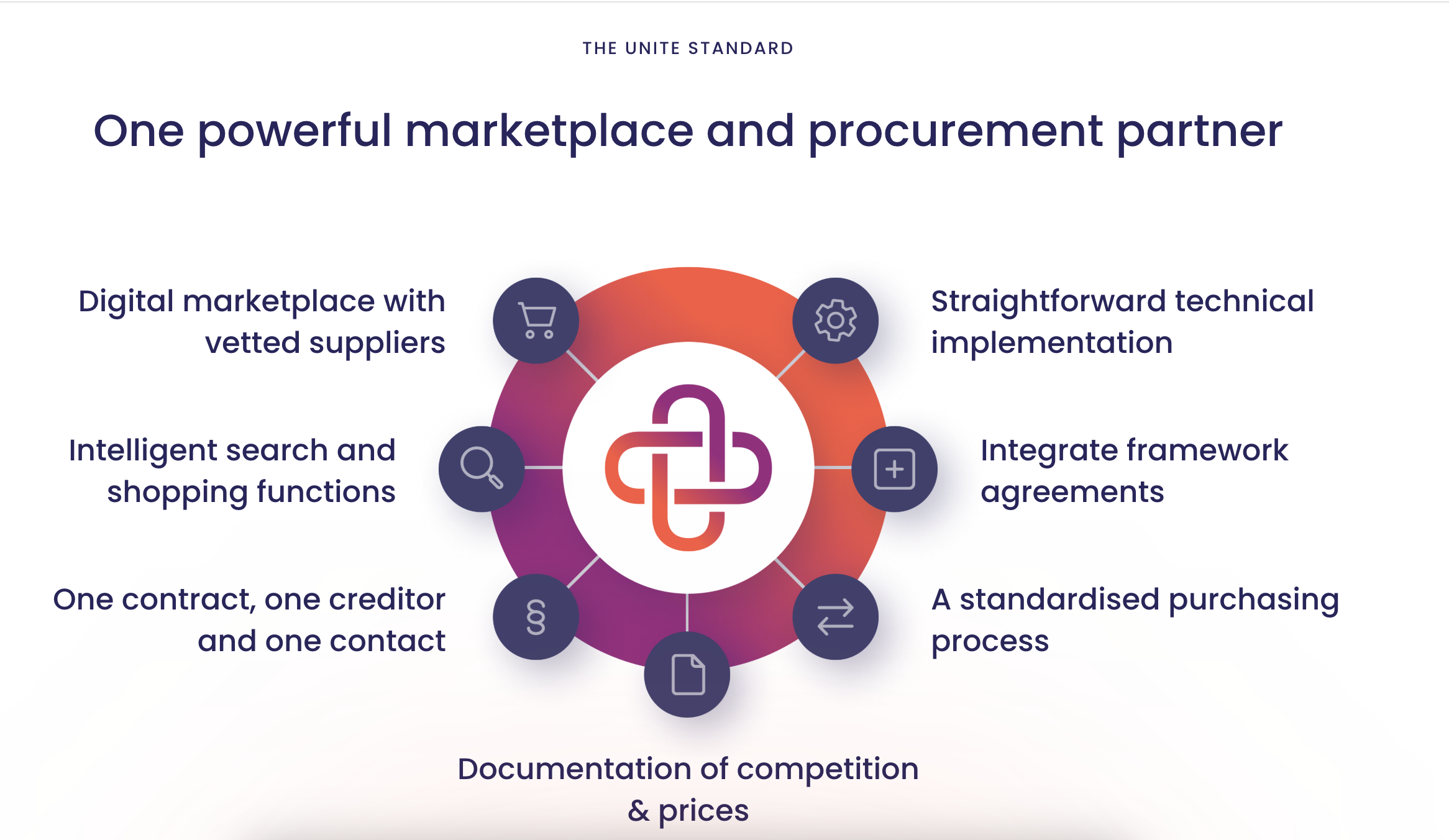
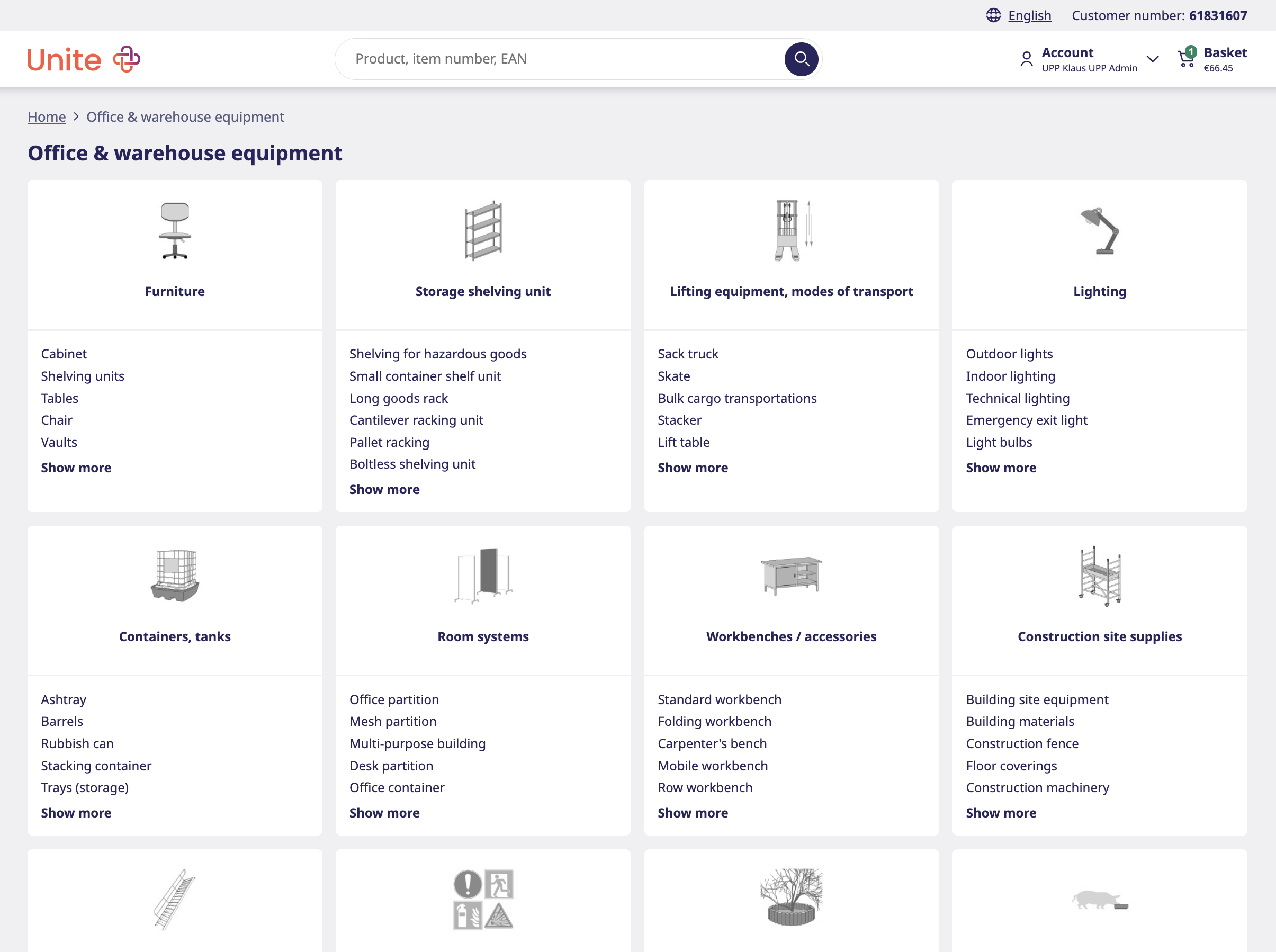
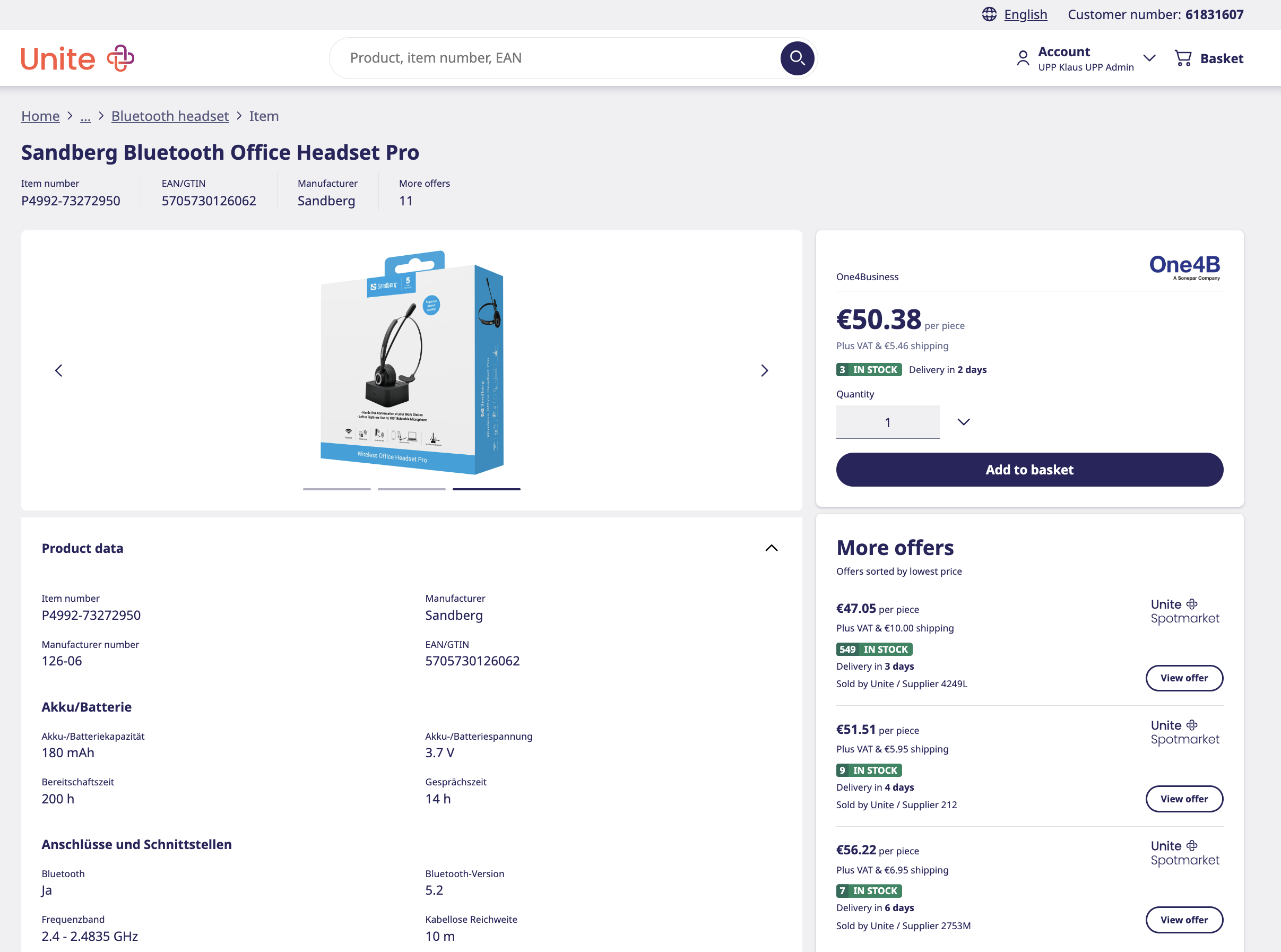
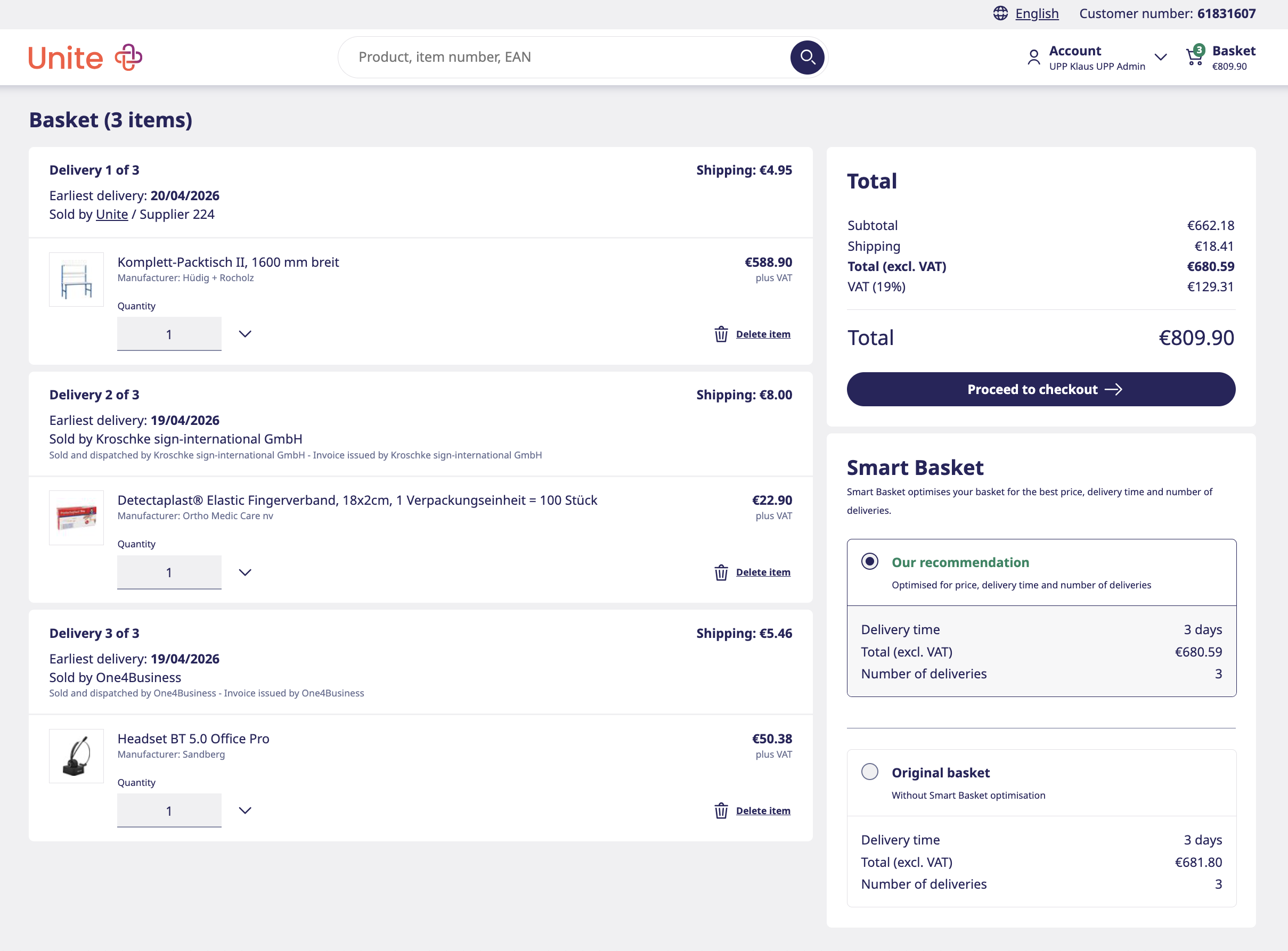
Unite Services platform — supplier catalogue and checkout flow
Company Unite Services GmbH · Munich
Role Product Manager · End-to-end ownership
Timeline 2024–2025
Scale ~150k buyers · 1,500+ suppliers · 12 countries

Not a UX facelift. Twenty years of decisions that needed unwinding.

Unite's procurement platform had been compounding complexity since the early 2000s. For a buyer in a German industrial company reordering safety gloves, a batch of cables, or a wireless headset, the experience felt dated: search returned noisy results, checkout routed them through steps designed for someone else's role, and the UI didn't work on anything that wasn't a desktop monitor. Sales conversations reflected this — the platform was increasingly hard to demo against modern alternatives, regardless of how strong the underlying supplier network was.

The temptation was to treat this as a UX facelift. It wasn't. Twenty years of feature accretion meant the real problem was deciding what the new platform should refuse to rebuild — and how to run two systems in parallel for years across 12 countries without breaking the ERPs our biggest customers had already integrated.

For buyers

Find the right product in one or two queries. See stock and delivery transparently. Export the basket to your ERP without fighting the interface. Reorder recurring items without starting from scratch.

For the business

A platform Sales can demo against modern alternatives — that large regulated customers can onboard without custom workarounds.


Five scoping decisions shaped everything that followed.

01

ERP-integrated customers first, not web-only customers

Counter-intuitively, this segment needed a smaller MVP surface — most business logic lived in the customer's ERP, not in our UI. That let us ship a thinner, more focused product and validate the architecture under the highest-integration-complexity conditions. I said no to Sales' preference for a multinational, multi-segment launch.

02

Germany first, even though the platform operates in 12 countries

Germany represented ~90% of revenue. Parallel rollout across all markets would have delayed the MVP by months and multiplied migration risk. I accepted short-term stakeholder dissatisfaction in other markets to protect the integrity of the core launch.

03

End-user procurement experience over strategic purchaser complexity

Strategic purchasing features — spend analytics, approval chains, framework agreement management — served a smaller population doing lower-frequency workflows. The end-user order and checkout flow was where conversion and NPS actually moved.

04

Coexistence over cutover

I refused to promise a full migration date. With engineering and selected ERP-integrated customers, we validated that legacy and new platform could run simultaneously against the same ERP integrations. That turned the migration from a risky event into a gradual shift — and removed the pressure to ship prematurely.

What I cut

Full feature parity with the legacy system. Advanced phrase and boolean search in the MVP — data showed users refined simple queries rather than constructing complex ones. Complete self-service user management for the MoD rollout, replaced with a phased model backed by structured data imports during refactoring. Each cut had an internal advocate. Each was deferred with an explicit reason.

The assumption underneath

In a 20-year-old B2B product, documented user roles under-represent actual behaviour. I committed to validating every segment decision with usage data and pilot feedback, not org charts — which turned out to matter more than expected when the shadow user group appeared in pilot.

Built first
  • ERP-integrated DE segment
  • End-user order workflows
  • Search relevance + synonyms
  • Basket Export to customer's ERP
  • Legacy + new coexistence
Cut
  • Multinational parallel launch
  • Full feature parity
  • Strategic purchaser UX
  • Hard migration cutover
  • Self-service user mgmt (MoD)
Deferred
  • Advanced phrase/boolean search
  • Complex approval chains
  • Spend analytics
  • Framework agreement mgmt
  • Regional market rollout

Three decisions that carried the project — including one I got wrong.

Decision 1 · Pilot with two customer segments before any scale decision

Rather than run a company-wide beta, we ran focused pilots with 5+ selected customers from each segment. The pilots were scoped small enough that we could actually act on feedback before the next increment. This is where we found the mistake that became the most useful learning in the project.

Decision 2 · A mistake I own

We launched the new platform as authenticated-only, aligned with leadership on security and data governance grounds. What discovery missed was a third, informal user group: employees who browsed and compared products, then handed requests to licensed buyers. This was a cost-avoidance pattern driven by ERP licensing, not a documented workflow. Closing access removed them. We corrected with a controlled pre-approval browsing capability, but I own the miss — I hadn't pushed hard enough on shadow workflows during discovery.

Decision 3 · Search relevance over search power

Data was unambiguous. Users did simple keyword searches and refined them rather than constructing advanced queries. More importantly, a large segment — especially customers with standardised hardware — didn't start from search at all; they reordered from shopping lists. MVP prioritised synonym handling, zero-result reduction, and surfacing shopping lists as a primary entry point. Advanced filter logic and phrase search were sequenced later, and some of it never justified its cost once relevance improved.

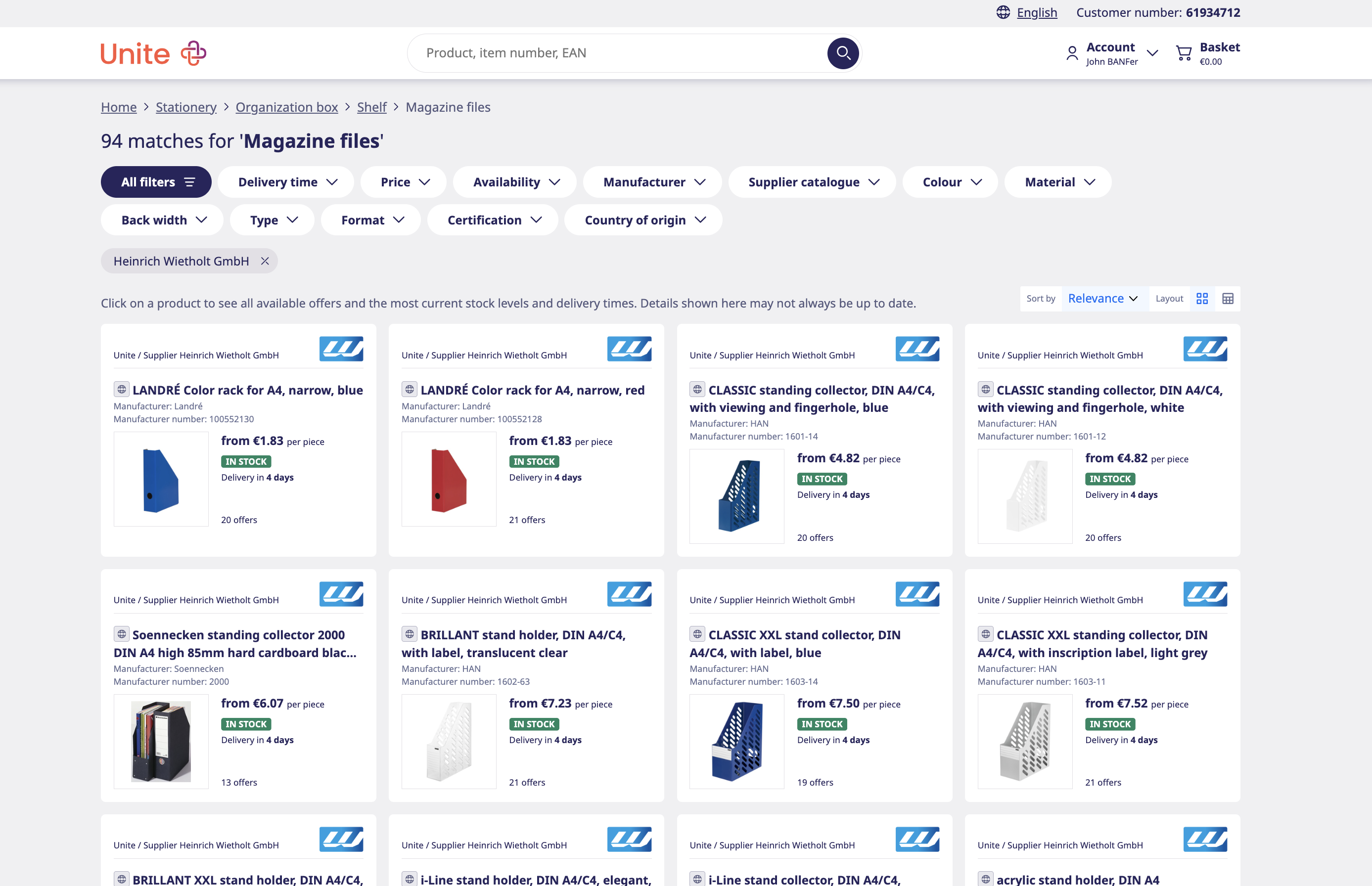
Search results — faceted filters, stock and delivery visible at card level

What actually shipped — and what I'm deliberately not claiming.

+5% Conversion uplift · pilot phase
+20 NPS improvement · pilot phase
12,000 Users scaled to UK Ministry of Defence
1,500→11k+ Max Planck Society users · pilot → 2026 path

Shipped & measurable

  • +5% conversion uplift in the pilot phase
  • +20 NPS improvement in the pilot phase
  • UK Ministry of Defence scaled to ~12,000 users via redesigned user management and multi-tenant infrastructure — after refactoring in response to pilot learning, not before
  • Six Max Planck institutes piloted (~1,500 users); nationwide path prepared for 90 institutes / 11,000+ users in 2026
  • Reduction in support tickets related to product discovery
  • Legacy and new platform coexisting against live ERP integrations — no forced customer cutover

Deliberately not claimed

  • The redesign didn't "solve" the platform. Full feature parity wasn't the goal and isn't achieved. Some legacy workflows are still served by the old system, by design.
  • The +5% / +20 NPS numbers come from the pilot cohort, which was deliberately chosen for high-frequency end-user workflows — the segment most likely to move those numbers. Impact on strategic purchasers is a separate question I'd want measured separately.
  • The MoD rollout worked because we phased capability delivery and used structured data imports to cover the gap while user-management was refactored. That's a delivery outcome, not a product-readiness outcome.
  • The MPG engagement required a mid-flight contractual renegotiation when the customer asked to skip straight to the new platform. The renegotiation went well. The original commitment could have been scoped more carefully.

What I'd do differently. What changed my mind. What transfers.

i.

Earlier, smaller MVP. I'd push for a visibly-shipped increment sooner, even at the cost of architectural completeness. The long discovery and architecture phase was defensible in isolation, but it cost executive momentum that became hard to rebuild when priorities shifted later. Tangible progress protects prioritisation better than good plans do.

ii.

Shadow workflows are a first-class research target, not an edge case. The research-only user group cost us pilot goodwill. Since then, I explicitly map cost-avoidance behaviours and licensing-driven workarounds during discovery. In B2B, licensing structure shapes behaviour in ways that documented roles don't capture.

iii.

Product needs to be in enterprise sales conversations earlier. The MoD commitment around self-service user hierarchy was made before Product was meaningfully involved. The technical constraints were real and knowable. Proactive alignment on what the product can and can't promise is cheaper than renegotiating with a sales team and a customer mid-delivery.

iv.

What transfers to AI product work. The judgment pattern is the same. Deciding what not to build, validating assumed user behaviour before committing, designing for coexistence with existing systems rather than replacement, staying honest about which outcomes generalise and which don't — these are the exact decisions that matter when the system you're shipping is a model rather than a UI. The technology changes; the scoping discipline doesn't.